
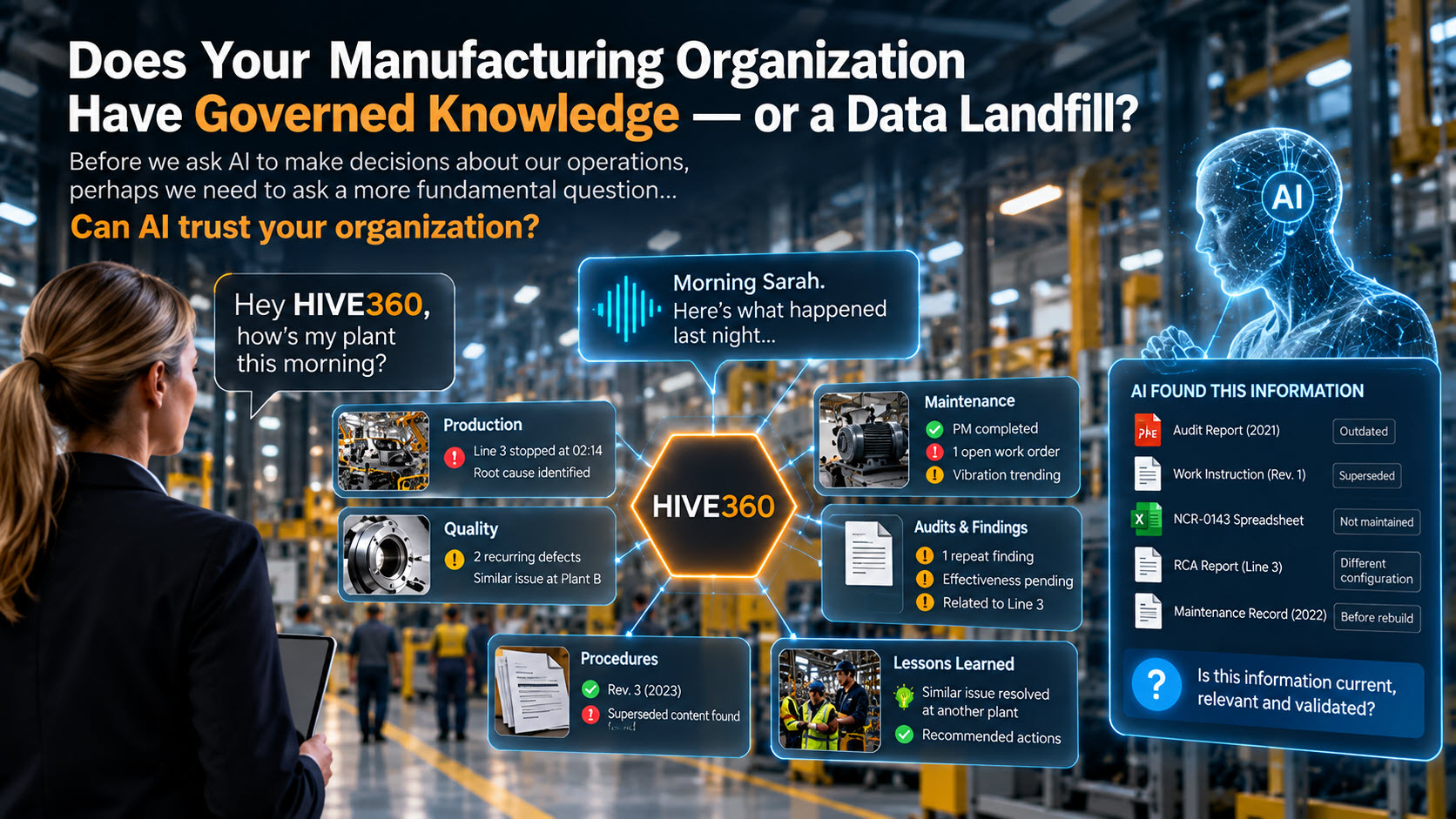
Does Your Manufacturing Organization Have Governed Knowledge — or a Data Landfill?
Does Your Manufacturing Organization Have Governed Knowledge — or a Data Landfill?
Manufacturing certainly isn't short of information.
For decades, we've accumulated production records, maintenance histories, audit findings, inspection results, non-conformances, corrective actions, root cause investigations, procedures, work instructions, training records, lessons learned, spreadsheets, PDFs, presentations and countless other documents.
Some of it sits inside ERP, MES, QMS and CMMS platforms. Some lives in SharePoint. Some sits on shared drives. And some probably exists in a spreadsheet created by someone who left the organization five years ago.
We've become very good at storing information.
Now we're entering another phase.
We're increasingly asking AI to help us find it, interpret it and, eventually, help us make decisions from it.
That raises a question I've been thinking about:
Before we ask AI to make decisions about our manufacturing operations, how well do we trust what it is finding, interpreting and telling us?
Because perhaps some organizations haven't spent the last twenty years building organizational knowledge.
Perhaps we've been building a data landfill.
Manufacturing Has a Lot of Data. But Is It Connected?
Hexagon's recently released State of Manufacturing Report 2026 provides an interesting backdrop.
In its survey of 511 U.S. manufacturing professionals, 77% described their operations as fully or mostly connected. Yet only 40% reported connectivity across design, production, quality and business systems, while 67% said they did not have data from most systems integrated into a single view. Hexagon
Those findings also formed part of the thinking behind my previous article, Is Your Manufacturing Organization Really Connected If Organizational Knowledge Can't Travel? LinkedIn
But that discussion raises another question.
Before organizational knowledge can travel, how do we know what deserves to be trusted as organizational knowledge in the first place?
Think about how much information a manufacturing organization creates every day.
A production problem generates a non-conformance. An audit identifies a finding. Maintenance responds to an equipment issue. An inspection records a condition. A team performs a root cause investigation. Corrective actions are assigned. A procedure gets revised. Someone updates a spreadsheet. Eventually, the problem is closed.
Every step creates information.
But what happens to that information afterward?
When Information Becomes a Data Landfill
Imagine a production line begins experiencing an intermittent quality problem.
Quality starts investigating. Maintenance gets involved. Production provides information. Engineering begins looking at possible causes.
Eventually someone says:
"Didn't we have something like this happen a few years ago?"
Now the search begins.
Was there an NCR? Did someone perform an RCA? Was there an audit finding? Which plant was it? Where was the report stored? Was there a lesson learned? Who worked on it?
Someone searches SharePoint. Someone looks through the QMS. Someone checks maintenance history. Someone finds an old spreadsheet. Eventually someone remembers that Dave was involved.
Except Dave retired last year.
The organization may already possess exactly the knowledge this team needs.
The problem is that nobody knows where it is, whether it's still relevant, or perhaps even that it exists.
That's when accumulated information starts looking less like organizational knowledge and more like a data landfill.
A data landfill doesn't necessarily mean an organization has bad systems. Every system involved may be doing exactly what it was designed to do.
The QMS stored the corrective action. The CMMS retained the maintenance history. SharePoint kept the document. The audit system preserved the finding. The spreadsheet still exists.
But storing something doesn't mean the organization learned from it.
An RCA can be completed without anyone outside that team benefiting from what was discovered. A corrective action can be closed without anyone knowing whether a similar condition exists somewhere else. An audit report can become a PDF nobody opens again. A lesson learned can be documented without ever becoming part of the next decision.
Manufacturing may not have an information shortage.
It may have a problem turning information into knowledge the organization can actually use.
Now We're Giving AI Access to It
This becomes much more important when AI enters the conversation.
Parsec's 2026 State of the Manufacturing Industry surveyed 1,200 manufacturing leaders globally and found that 72% had adopted AI in some form, yet only 10% had deployed it at scale. The research also found that only 37% had a unified, data-driven strategy in place and identified fragmented systems and inconsistent data strategies among the constraints manufacturers are still working through. Parsec
Deloitte's 2026 Manufacturing Industry Outlook similarly points to opportunities for AI to capture institutional knowledge and improve manufacturing operations, while identifying data, technology, governance and workflow transformation as important considerations for scaling agentic AI. Deloitte
There's enormous potential here.
But consider what happens when AI begins doing more than finding documents.
What happens when we ask it to interpret what's happening in the plant and recommend what we should do next?
Imagine asking:
"Why is this machine experiencing repeated failures?"
The AI searches the information available to it.
It finds maintenance records. An RCA. An audit report. A work instruction. Production history. An inspection result. A spreadsheet containing historical maintenance intervals.
It analyzes everything and provides a convincing answer.
There's just one problem.
The machine was rebuilt eighteen months ago.
The component specification changed. The lubrication system was upgraded. The preventive maintenance frequency changed. The old audit finding was closed. And the spreadsheet the AI relied upon hasn't been maintained in four years.
Nothing the AI found was necessarily fake.
The audit really happened.
The spreadsheet really existed.
The maintenance history was real.
The work instruction really was once approved.
Every source could be authentic, and the answer could still be operationally wrong.
That's a very different problem from AI hallucination.
The AI didn't invent the information.
The context changed.
Can AI Trust Your Organization?
We spend a lot of time discussing whether organizations can trust AI.
Perhaps we should also ask whether AI can trust the organization.
If we're going to allow AI to influence manufacturing decisions, it isn't enough for the information it retrieves simply to exist.
Is it current?
Is it authoritative?
What plant, process, product, line or equipment does it apply to?
What configuration existed when the information was created?
Was the root cause validated?
Was the corrective action verified as effective?
Was the procedure superseded?
Did the problem subsequently recur?
Is there conflicting evidence somewhere else?
And perhaps most importantly:
How does the person making the decision know why the AI reached its conclusion?
The more authority we give AI, the more important the provenance and context behind its answers become.
A confident answer isn't necessarily a trustworthy answer.
And connecting AI to a data landfill doesn't automatically create organizational intelligence.
It may simply give the landfill a very sophisticated chatbot.
From Stored Information to Governed Organizational Knowledge
This is where I think manufacturing has an interesting opportunity.
Instead of simply asking how we connect AI to more data, perhaps we should think about how operational information becomes organizational knowledge in the first place.
What happened? Where did it happen? Under what conditions? What evidence supports the conclusion? What did we try? What worked? What didn't? What changed? Who validated it? Did the improvement actually hold? Where else might that experience matter?
Those relationships provide context.
And context allows us to move from simply accumulating records toward something closer to:
DATA → EVIDENCE → CONTEXT → UNDERSTANDING → DECISION → ACTION → VERIFICATION → KNOWLEDGE
Then something important changes.
Knowledge doesn't have to sit somewhere waiting for somebody to remember that it exists.
It can become available when the organization encounters something relevant again.
Imagine that same production problem occurring eighteen months later at another plant.
Instead of starting with a blank sheet of paper, the organization can surface a similar previous event, the evidence surrounding it, the root cause that was identified, what corrective action was implemented, whether that action proved effective and what the organization ultimately learned.
It isn't automatically telling the new plant to copy the previous solution.
Different equipment, materials, products, processes and operating conditions may mean the answer is different.
It's simply saying:
"We've seen something similar before. Here's what the organization already knows, here's why we believe it, and here's the evidence behind it."
People still investigate.
People still validate.
People still make the decision.
But they aren't starting from zero.
What If AI Could Understand What Your Organization Actually Knows?
This is one of the questions we're working on with HIVE360.ai.
Manufacturers don't need another place to dump information. They already have plenty of those.
The opportunity we're exploring is how operational activity, evidence, organizational knowledge and AI can remain connected so that what the organization learns doesn't disappear when an NCR is closed, an audit is completed, a spreadsheet is filed away or an experienced employee leaves.
That also means AI shouldn't simply find information and declare it true.
It needs context, history, relationships, evidence, freshness, validated outcomes and human expertise around what it finds.
Sometimes the most trustworthy answer an AI system can provide may be:
"I don't have sufficient current, validated evidence to answer that confidently."
That's considerably more useful than a perfectly written recommendation based on a spreadsheet that hasn't been relevant to the machine for four years.
AI can help surface patterns, connect evidence and bring relevant organizational experience into the conversation.
People still need to investigate, challenge, validate and make decisions.
The objective isn't to make AI omniscient.
It's to help the organization better understand and use what it actually knows.
Perhaps We're Asking the Wrong Trust Question
Manufacturing's adoption of AI is accelerating rapidly. Parsec's research suggests that the experimentation stage is already well underway, even if enterprise-scale deployment remains relatively limited. Parsec
As that changes, we're going to ask AI increasingly consequential questions about quality, maintenance, production, risk, operational performance and improvement.
So perhaps before asking:
"Can we trust AI to help make decisions about our manufacturing operations?"
we need to ask something first:
Can AI trust the information our organization is giving it?
Because twenty years of accumulated data doesn't necessarily equal twenty years of organizational knowledge.
The advantage may not belong to the manufacturer with the most information.
It may belong to the manufacturer that understands what it knows, why it knows it, whether it can still trust it, where else it matters and when that knowledge should become relevant again.
So I'll leave you with two questions.
Does your manufacturing organization have governed organizational knowledge — or a data landfill?
And if you're preparing to let AI reason across that information:
Can AI trust your organization?
I'd be interested to hear how plant managers, manufacturing leaders, Quality, Maintenance, Operational Excellence and IT teams see it.
Industry sources referenced: Hexagon, State of Manufacturing Report 2026; Parsec, 2026 State of the Manufacturing Industry; Deloitte, 2026 Manufacturing Industry Outlook. Hexagon