Is Your Manufacturing Organization Really Connected If Organizational Knowledge Can't Travel?
The manufacturing industry is telling us that operations are increasingly connected. But despite that connectivity, production, quality, engineering and business systems often remain fragmented, within individual plants and across global manufacturing operations.
So here's a question:
Is your manufacturing organization really connected if organizational knowledge can't travel?
Hexagon released its State of Manufacturing Report 2026 this week, and the findings provide an interesting backdrop to this question. In its survey of 511 U.S. manufacturing professionals, 77% described their operations as fully or mostly connected. Yet only 40% said they were connected across design, production, quality and business systems, while 39% reported limited feedback between design, manufacturing and quality teams.
That gap got me thinking.
Manufacturers have spent years connecting machines, systems, processes and data. But have we really connected what the organization knows?
Think about what happens when a production line stops, quality identifies a recurring defect or potential non-conformance, maintenance finds an unusual equipment condition, or an investigation identifies a potential root cause. Corrective actions are implemented, production resumes and eventually the issue is closed.
Six months later, another shift, another line, or perhaps another plant encounters essentially the same problem. Does that team inherit everything the organization learned the first time, or do they start again?
If they start again, perhaps the organization isn't quite as connected as we think it is.
Your Organization May Already Know the Answer
Manufacturing organizations accumulate enormous amounts of experience through their daily operations. It exists in corrective actions, maintenance records, audits, inspections, shift handovers, root cause investigations, non-conformance findings, work instructions, lessons learned, process changes, various manufacturing documents, spreadsheets, shared drives, emails and countless other places.
And, of course, much of it exists in the heads of our people, as what we often call "tribal knowledge."
It's the maintenance technician who recognizes a sound that isn't normal, the operator who knows a particular product behaves differently during startup, the quality engineer who remembers why a process parameter was changed five years ago, or the supervisor who remembers that the obvious workaround was tried before and created another problem.
We often describe this as tribal knowledge. But it's also organizational experience.
The problem isn't necessarily that the organization doesn't know the answer. The problem may be that the organization doesn't know what it knows or even how to access it.
Manufacturing certainly isn't short of data. We have MES, ERP, QMS, CMMS, sensors, data historians, spreadsheets, SharePoint, dashboards and reports. We've become extraordinarily good at recording operational activity.
But recording experience isn't the same as remembering it.
Organizational knowledge requires context. What happened? Under what conditions? Why did it happen? What did we try? What worked and what didn't? What changed? Did the improvement actually hold? Where else might that experience be relevant?
Without that context, we can accumulate years of operational information while still depending on somebody saying, "Call Dave. He'll remember what happened last time."
And What Happens When Dave Retires?
This is where the issue becomes more significant. When an experienced employee leaves manufacturing, we don't simply lose a pair of hands. We can lose judgment, context, exceptions, early warning signs and years of accumulated experience about how the operation actually behaves.
Deloitte's 2026 Manufacturing Industry Outlook specifically identifies capturing institutional knowledge from retiring employees as an area where AI may create value. Deloitte also points to AI's potential to accelerate knowledge sharing while keeping people at the center of manufacturing.
That raises a more useful succession-planning question than simply asking what an employee does. What decisions do they make? What problems do they prevent? What do they recognize that others don't? What do they know that the rest of the organization cannot easily find?
A new employee can read a work instruction. What takes much longer to acquire are the signals, exceptions, trade-offs and experiences behind it.
And an organization doesn't learn from data alone. It learns through its People | Process | Technology | Culture, and through the relationships between them.
An operator notices something unusual. A process creates evidence. Equipment history adds context. An investigation helps establish root cause. A corrective action changes the process. Verification tells us whether it worked. Culture influences whether that experience is surfaced, trusted, shared and used again.
Each interaction potentially creates another piece of organizational knowledge. The question is whether those pieces remain isolated or become part of what the organization already knows and continues to learn, ultimately becoming part of the plant's operational DNA.
That's also why closing a problem isn't necessarily the same as learning from it. An RCA can identify root cause without that knowledge ever reaching another plant. A corrective action can be closed without proving that recurrence has been prevented. A lesson learned can be documented without anyone ever finding it again.
Perhaps the better measure is whether the problem returned, whether another team benefited from the experience and whether the next investigation started with what the organization already knew.
Can Operational Knowledge Travel Across Teams and Plants?
For me, this may be one of the simplest tests of whether organizational knowledge is truly connected.
When a team solves a meaningful problem, can that operational knowledge move from one person to another, from night shift to day shift, from production to quality, maintenance or engineering, from one line to another, from one plant to another, and ultimately across an entire global manufacturing organization?
And can it travel with enough context that the receiving team understands not only what was done, but why it was done and whether that experience actually applies to their situation?
Because blindly copying a solution isn't organizational learning either. Equipment may differ. Materials may differ. Products, processes, people and operating conditions may differ.
The objective isn't simply to distribute answers. It's to make relevant organizational experience available to the right people, at the right time, to help make better-informed decisions.
What If We Introduced AI to the Conversation?
This is where things get particularly interesting.
Parsec's 2026 State of the Manufacturing Industry surveyed 1,200 manufacturing leaders globally and found that 72% had adopted AI in some form, but only 10% had deployed it at scale. The report also describes fragmented systems, inconsistent data strategies and workforce constraints as factors limiting progress.
So before asking, "What can AI do for our plant?" maybe we should first ask:
"What does our organization actually know that AI can help our people benefit from?"
If maintenance history lives in one system, corrective actions in another, manufacturing documents somewhere else, lessons learned in another repository, shift information in another location, and critical operational experience remains in people's heads, adding AI doesn't automatically create organizational intelligence.
AI needs something meaningful to work with: connected evidence, operational context, history, relationships, validated outcomes, human expertise and governance.
That's when AI becomes much more interesting: as a way to support the people across the organization by helping them access relevant organizational experience, insights and context when they need it.
What If Your Plant Could Remember?
This thinking ultimately led us to build HIVE360.ai.
Manufacturers don't need another place to dump information. They already have plenty of those.
We started with a different question:
What would happen if your plant could actually remember what the organization already knows, and continue to learn from every daily activity?
Imagine it remembering what happened, what was tried, what worked and what didn't. What another shift learned. What another plant discovered. Why a particular decision was made and whether the resulting improvement actually held.
But remembering is only part of the opportunity.
What if AI could help connect that operational knowledge, surface relevant insights, provide guidance based on what the organization already knows, and help turn new experience into lessons learned that can be shared across the plant and the entire organization?
Each new activity adds context. Each investigation can add knowledge. Each verified outcome can strengthen what the organization knows. Each lesson learned has the potential to help someone else avoid starting from zero.
The organization doesn't just preserve its knowledge. It continues to learn from its own experience.
What If You Could Talk to Your Plant?
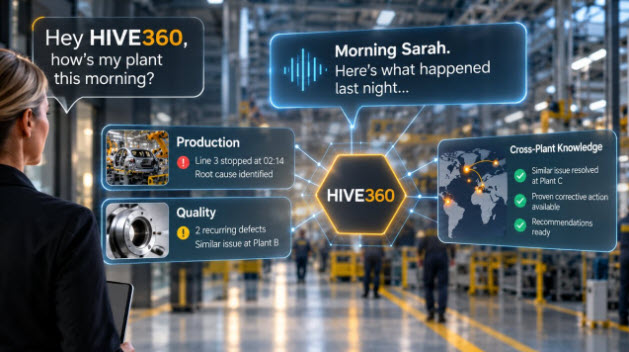
Imagine arriving at the plant tomorrow morning and simply asking:
"Hey HIVE360, how's my plant this morning?"
And your plant responds:
"Morning Sarah. Here's what happened last night..."
Instead of another dashboard filled with red, yellow and green indicators, imagine being able to explore the operational story behind what you're seeing. Ask questions. Dig deeper into the issues. Connect what's happening now with relevant evidence, history and organizational knowledge that may exist elsewhere across the plant or the wider organization.
That doesn't replace shift handovers, production meetings or the conversations already happening between people. It gives those conversations access to something they haven't traditionally had: the accumulated operational knowledge and experience of the wider organization.
That's the thinking behind HIVE360.ai.
It's about connecting daily operational activity, evidence, organizational knowledge and AI so people across the plant can benefit from what the organization already knows and make better-informed decisions. From production and maintenance to quality, engineering, audits, inspections and leadership, each activity contributes to a more complete understanding of what's happening across the plant and why.
People still investigate, inspect, audit, validate, solve problems and make decisions. AI helps connect the evidence, experience and context surrounding those activities so the organization can continue to learn from them.
Perhaps the next step in connected manufacturing isn't connecting another machine, system or data source.
Perhaps it's connecting what the organization knows.
Because somewhere in your business, the answer may already exist. And if it doesn't, someone may be learning it right now.
The real question is whether that experience becomes organizational knowledge the rest of the business can use.
How much of what your organization needs to know has already been learned somewhere else inside the business?
And ultimately:
Is your manufacturing organization really connected if organizational knowledge can't travel?
I'd be interested to hear how plant managers and other manufacturing leaders see it.
Industry sources referenced: Hexagon, State of Manufacturing Report 2026; Parsec, 2026 State of the Manufacturing Industry; Deloitte, 2026 Manufacturing Industry Outlook.