
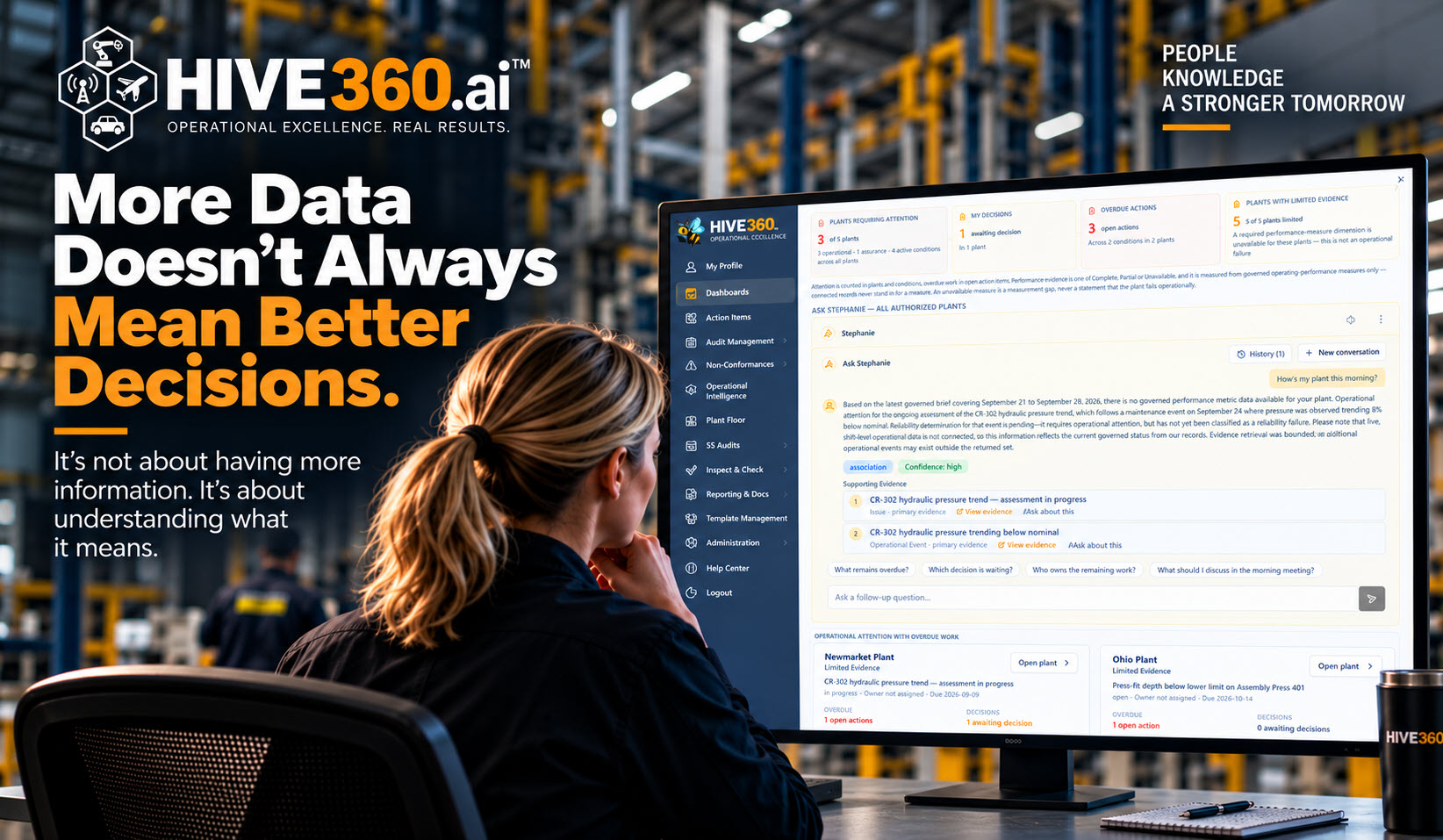
Manufacturing Doesn't Have a Data Problem. It Has a Decision Problem.
We've given Plant Managers more information than ever before. But are we helping them make better decisions?
Another Morning. Another Production Meeting.
It's 7:30 in the morning, and the Plant Manager is getting ready for the daily production meeting.
Chances are, their day started well before that. They may have already reviewed the overnight production results, received an escalation from the previous shift, or walked the floor to see firsthand what's happening.
Production has its numbers. Quality has its reports. Maintenance has updated the equipment history, and Engineering is working through several outstanding issues. Someone has probably already circulated a spreadsheet showing yesterday's performance against the production schedule.
There's a lot to review, and not much time to review it.
Line 2 missed its production target. Line 3 had an intermittent quality problem. Maintenance completed a repair overnight, and a customer order is already running behind schedule.
Nothing particularly unusual about any of that. It's manufacturing.
And that's assuming the morning goes according to plan. A critical machine could go down, a supplier delivery could be delayed, or a customer could call about an urgent quality concern before the meeting even begins.
The meeting begins, and everyone reports what happened in their respective departments. Production explains the downtime. Quality reviews the defects and the containment already underway. Maintenance confirms the repair was completed and the equipment was returned to service following the required checks. Engineering provides an update on the outstanding investigations and corrective actions.
Then someone asks whether the quality issue on Line 3 could be related to the equipment problem Maintenance investigated last week.
Nobody is quite sure.
Production believes the machine is running within its established parameters. Maintenance says the equipment is operating as expected following the repair. Quality has documented the defects and initiated containment, but the root cause hasn't been established. Engineering is still reviewing the process.
The Plant Manager isn't expected to personally determine the root cause. That's why the organization has experienced Quality, Engineering, Maintenance and Production teams.
But someone still needs to understand the operational implications. Is the containment adequate? Are the right resources assigned? Is there potential customer exposure? Can production continue within the organization's safety and quality requirements? And if the issue isn't resolved by the next shift, what happens to the delivery schedule?
Some decisions will sit with Quality or other designated functions under established procedures. Others require the Plant Manager to coordinate priorities, allocate resources, resolve competing demands or escalate the situation.
And there's the problem.
Everyone came to the meeting with information. Nobody necessarily came with enough understanding to make the next decision straightforward.
I've been thinking about this quite a bit lately, particularly as manufacturers continue investing in digital transformation, connected factories, advanced analytics and artificial intelligence.
We've become remarkably good at showing manufacturing leaders what's happening inside their operations.
But have we become equally good at helping them understand what to do about it?
Everyone Has a Dashboard. Does Everyone See the Same Plant?
Manufacturing has made tremendous progress in operational visibility.
A Plant Manager can review production performance, downtime, first-pass yield, scrap, maintenance activity and schedule attainment without waiting for someone to assemble a stack of reports. Many facilities can display this information in real time.
That's a significant improvement over how manufacturing operated twenty years ago.
But having access to information and having a shared understanding of the operation aren't necessarily the same thing.
Hexagon's 2026 State of Manufacturing Report provides an interesting perspective. The research surveyed 511 manufacturing professionals in the United States, ranging from entry-level employees to senior executives.
While 77% described their operations as fully or mostly connected, only 40% reported connectivity across design, production, quality and business systems.
Perhaps more revealing was the difference in perception between management and the people working on the shop floor.
Eighty percent of executives believed their data was integrated. Among entry-level employees, that figure dropped to just 33%.
Think about that for a moment.
People working in the same manufacturing organizations have dramatically different perceptions of how connected their operations actually are.
That doesn't necessarily mean either group is deliberately misrepresenting reality. It suggests that what leadership sees through its reporting systems may be quite different from what employees experience while trying to get their jobs done.
A Plant Manager sits somewhere in the middle of that reality.
Corporate leadership wants performance, consistency and predictable results. Production needs equipment running. Quality needs processes under control. Maintenance needs time to address emerging problems before they become failures.
And the Plant Manager has to bring those perspectives together, often while making decisions that affect all of them.
A dashboard can tell everyone that production is behind schedule.
It doesn't necessarily explain whether the most responsible decision is to increase output, stop and investigate a quality concern, or address an equipment condition before it creates a larger problem.
That's not a reporting decision.
It's an operational judgment.
The Problem Nobody Saw Coming
Let's return to Line 3.
The quality problem has been intermittent. A small number of components are failing dimensional inspection, but the defects aren't occurring consistently enough to establish an obvious pattern.
Quality has opened a non-conformance and initiated containment in accordance with the organization's procedures. Production confirms that the process parameters haven't changed. Maintenance has checked the equipment and found nothing that would explain the variation.
The investigation is underway, with Quality and Engineering evaluating potential causes and Production assessing the impact on the schedule.
During the review, someone asks whether anything unusual happened before the first defects appeared.
A Production Supervisor recalls an observation raised by an operator during an earlier shift handover.
The operator had noticed that the machine was behaving slightly differently since a new batch of material was introduced. Nothing dramatic. No alarms. No obvious equipment failure. Just a small difference in how the process responded during certain parts of the production cycle.
The observation had been passed along, but nobody had connected it to the dimensional defects.
It wasn't in the maintenance history because nobody had requested a repair. And it hadn't been incorporated into the quality investigation because its potential relevance wasn't yet understood.
Now the team has a new direction to explore.
Purchasing confirms the material came from an approved supplier and met the documented specifications. Engineering begins examining whether a variation within those specifications could interact with the existing process conditions.
Perhaps the material is contributing to the problem. Perhaps it isn't. The team still needs evidence before reaching a conclusion.
But an observation from the shop floor has changed the direction of the investigation.
This is a hypothetical example, but it illustrates something manufacturing professionals encounter regularly.
The information needed to understand a problem doesn't always arrive neatly packaged inside one system or one department. Sometimes the important connection only becomes apparent when people bring together information that was never intended to be examined as a single story.
And sometimes the missing piece comes from an operator who noticed something nobody thought to ask about.
We've Invested Heavily in Visibility. What About Understanding?
According to Deloitte's 2026 Manufacturing Industry Outlook, 80% of 600 manufacturing executives surveyed in 2025 planned to allocate at least 20% of their improvement budgets to smart manufacturing initiatives.
That's a substantial commitment to technology, and there are good reasons for it.
Automation, sensors, production monitoring, analytics and connected systems can help manufacturers improve productivity, quality and operational performance.
But I'd argue that manufacturers should be asking another question alongside their technology investment decisions.
How much of that investment helps people make better decisions?
There's an important difference between identifying a performance deviation and understanding the circumstances behind it.
Suppose the morning dashboard shows that a production line experienced 47 minutes of unplanned downtime overnight.
That's useful.
But was the downtime caused by an equipment failure, a material shortage, an operator intervention or a process condition that has been developing for several shifts?
Did Maintenance recognize a similar condition last month? Was an engineering change implemented recently? Did the previous shift report an unusual observation that never made it into the formal downtime record?
And if the same issue occurred six months ago, what did the organization learn from it?
These questions aren't necessarily answered by adding another chart to the dashboard.
In fact, the more information a Plant Manager receives, the more important it becomes to understand which information deserves attention and how the different pieces relate to one another.
This isn't an argument against dashboards. They're essential tools for managing operations.
It's an argument against confusing visibility with understanding.
The distinction isn't new, either.
In a paper titled Contextualizing Manufacturing Data for Lifecycle Decision Making, researchers from the U.S. National Institute of Standards and Technology examined the challenge of connecting manufacturing information across different stages of the product lifecycle.
Their work, published in 2018, identified the importance of placing manufacturing data into the appropriate context so it could become useful knowledge for decision-making.
Nearly a decade later, with far more sophisticated technology available, the underlying challenge remains relevant.
We can collect enormous amounts of operational information.
But information doesn't automatically explain itself.
When Yesterday's Decision Becomes Tomorrow's Problem
There's another side to manufacturing decision-making that doesn't receive nearly enough attention.
What happens after the decision is made?
Imagine the Plant Manager ensures that the appropriate teams have the resources and support needed to address the Line 3 issue. Quality maintains the required containment, Engineering evaluates the process conditions, and Maintenance performs additional checks.
The Plant Manager monitors the operational impact, makes sure responsibilities are clear, and helps resolve obstacles that could delay the investigation.
Eventually, the team identifies a contributing condition, implements corrective actions and closes the investigation.
Production returns to normal. Scrap decreases. The customer order gets back on schedule.
Problem solved?
Hopefully.
But how do we know?
Did the corrective action eliminate the underlying cause, or did the process simply return to a period of stable operation?
Was effectiveness verified under the conditions that originally produced the defect?
Did the organization capture the operator's observation that helped redirect the investigation?
And if another production line experiences something similar next month, will anyone know what this team discovered?
This is where I think the conversation becomes particularly important for Operational Excellence.
We spend considerable effort identifying problems, assigning corrective actions and tracking their completion. But completing an action and proving that it worked are two different things.
An action can be closed on time and still fail to prevent recurrence.
A root cause investigation can be technically complete without its findings ever influencing another decision.
A lesson learned can be documented and still remain invisible to the people who would benefit from it.
The issue isn't always that manufacturers don't know how to solve problems.
Sometimes it's that the organization doesn't consistently carry the learning forward.
And that creates an interesting situation.
A Plant Manager can be looking at a problem today that the organization already spent considerable time and money investigating somewhere else.
Except nobody in the room knows it.
What If the Organization Has Already Seen This Before?
For manufacturers operating multiple facilities, this becomes an even bigger consideration.
Imagine a company with twenty-six plants.
One facility encounters a recurring quality issue, completes a thorough investigation, implements corrective actions and verifies their effectiveness. Six months later, another plant experiences a similar problem.
The second plant begins its own investigation, unaware that colleagues elsewhere in the organization have already worked through something potentially relevant.
Engineering spends time evaluating possible causes. Quality gathers evidence. Maintenance reviews equipment conditions. Production deals with the disruption.
Eventually, somebody remembers hearing about a similar issue at another facility.
A few phone calls later, the earlier investigation surfaces.
Now, the two problems may not have the same root cause. Different equipment, materials, operating conditions or process configurations could make the situations quite different.
But wouldn't the second Plant Manager want to know that the previous investigation existed before committing time and resources to starting from scratch?
That's the distinction.
The value isn't in automatically copying another plant's corrective action. It's in having access to relevant experience, understanding the circumstances surrounding it and using that knowledge to guide the current investigation.
I explored the broader issue of organizational knowledge sharing in an earlier HIVE Insights article, Is Your Manufacturing Organization Really Connected If Organizational Knowledge Can't Travel? But there's an important decision-making implication here.
If one plant learns something valuable and the rest of the organization never benefits from it, the company may be improving individual facilities without becoming a more knowledgeable organization.
And when the same types of problems keep appearing, that can become an expensive way to operate.
AI Can Find the Information. Can It Help Us Make Sense of It?
Artificial intelligence introduces a new possibility into this discussion.
For years, manufacturers have accumulated operational information across production systems, maintenance platforms, quality records, engineering documentation and countless other sources.
Now we're beginning to use AI to explore that information in ways that weren't practical before.
A Plant Manager might eventually be able to ask a straightforward question:
"What's changed in my plant since yesterday, and what should I be concerned about?"
That's a much more interesting question than asking a dashboard to display another production metric.
But there's a catch.
The AI needs to understand more than the information it can retrieve.
It needs to distinguish between current and outdated records, recognize when operating conditions differ, identify whether previous corrective actions were effective and make the supporting evidence available for review.
Otherwise, a convincing answer could simply be a well-written interpretation of incomplete information.
That's something I explored in my previous article, Does Your Manufacturing Organization Have Governed Knowledge — or a Data Landfill?
And it's why I don't believe the objective should be to have AI make operational decisions on behalf of Plant Managers.
The opportunity is to help people understand their operations more effectively.
Imagine being able to explore a recurring quality problem alongside relevant maintenance history, previous investigations, operator observations and the results of earlier corrective actions.
Not because an AI system has somehow discovered the answer to every manufacturing problem, but because it can help bring relevant evidence and organizational experience into the conversation.
People still need to investigate. Engineering still needs to validate technical conclusions. Quality still needs to assess risk and containment. Maintenance still needs to evaluate equipment conditions.
And the Plant Manager remains accountable for the operation, coordinating the response and ensuring appropriate decisions are made within the organization's established authority and requirements.
AI shouldn't eliminate that responsibility.
It should help people exercise it with a better understanding of the situation.
Maybe We're Measuring the Wrong Improvement
This brings me back to something I've been considering as we develop HIVE360.ai.
Manufacturers have invested in systems that do an increasingly good job of recording what happens inside their operations. Many of those systems are essential, and nobody should underestimate the value they provide.
But the next opportunity may not be another system for collecting information.
It may be finding better ways to connect operational activity, historical evidence and the experience of the people working in the plant, so that knowledge becomes available when it can influence a decision.
That's part of the thinking behind HIVE360.
We're exploring how manufacturers can move beyond simply reviewing operational information toward having a more meaningful conversation about what's happening in their plants, what the organization has learned and what deserves attention.
Not to replace the judgment of experienced manufacturing professionals, but to support it.
Because the real test of operational intelligence isn't how impressive the technology looks during a demonstration.
It's whether it helps someone recognize a developing problem, ask a better question, avoid repeating an earlier mistake or make a more informed decision when the pressure is on.
And that brings us back to the morning production meeting.
The Plant Manager has the reports. The dashboards are updated. Production, Quality, Maintenance and Engineering have all contributed their information.
The question is whether the organization has helped that manager understand what matters, what the available evidence supports and what still needs to be investigated.
Manufacturing will continue collecting data. We'll continue building dashboards, connecting equipment and introducing increasingly sophisticated AI capabilities.
Those investments will undoubtedly create opportunities.
But perhaps we should start measuring something beyond how much information our systems can collect or how quickly they can display it.
Perhaps we should ask whether our people are making better decisions because of it.
Because at the end of the day, a Plant Manager isn't measured by how many dashboards they review. They're accountable for the safety of their people, the quality of what leaves the plant, the performance of the operation and the commitments made to customers.
And when tomorrow morning's production meeting begins, the question won't simply be whether everyone knows what happened yesterday.
It will be whether the organization knows enough to make the right decisions today.
I'd be interested to hear how Plant Managers and manufacturing leaders see this challenge. Has greater operational visibility genuinely improved decision-making in your facility, or are people still spending too much time connecting the dots?
Industry sources referenced
Hexagon — 2026 State of Manufacturing Report, September 2026.
Deloitte — 2026 Manufacturing Industry Outlook, November 2025.
National Institute of Standards and Technology — Contextualizing Manufacturing Data for Lifecycle Decision Making, 2018.