

Operational Excellence Doesn't Happen in Silos
Why connecting people, processes and organizational knowledge matters across the entire manufacturing value chain.
Every manufacturing organization has its own operational DNA.
It's shaped by the people who work there, the processes they follow, the equipment they operate, the decisions they make and the experience they accumulate, day after day, shift after shift.
And that DNA never stops evolving.
Together, these people, processes, equipment, experiences and relationships form what we call the HIVE.
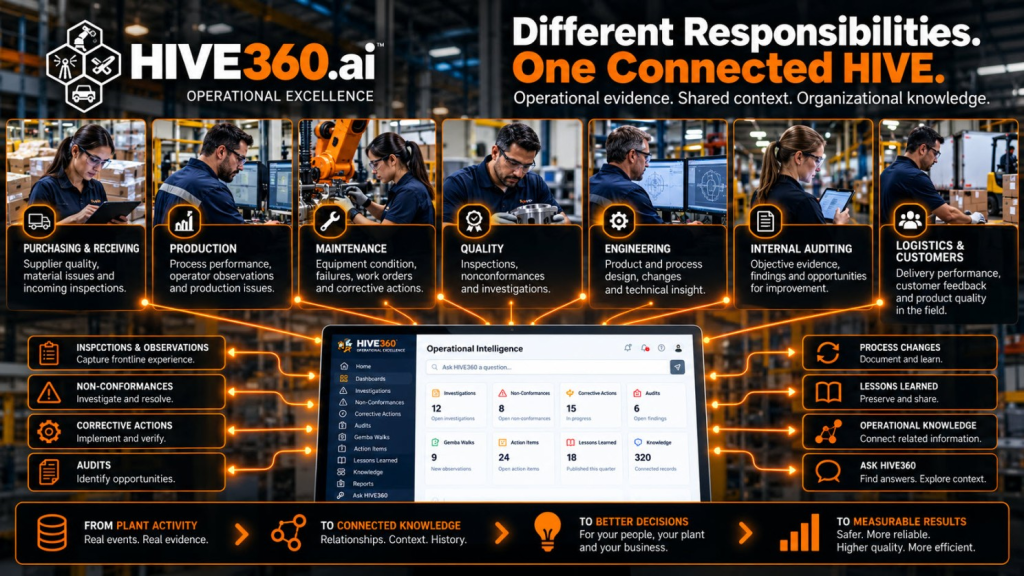
Every department has different responsibilities, but everyone contributes to a common purpose: consistently producing high-quality products that meet or exceed customer expectations.
Continuous Improvement is part of how the HIVE evolves.
An operator identifies an opportunity to improve a process. Maintenance resolves a recurring equipment issue. Quality investigates a nonconformance. Engineering improves a process control. An internal auditor identifies a weakness. Leadership verifies whether improvements are delivering the intended results.
Each activity contributes to the organization's operational DNA.
But here's the question.
If everyone contributes to the same manufacturing process, why does so much of the knowledge generated along the way remain disconnected—and why do the same problems keep coming back?
Manufacturing is a collective effort
Consider what happens as material moves through a manufacturing organization.
Purchasing works with suppliers to obtain the materials and components required for production. Receiving verifies incoming deliveries. Quality may inspect materials against established requirements. Production Planning coordinates schedules and resources. Engineering defines the processes and controls needed to manufacture the product.
Production transforms those materials into finished goods, supported by Maintenance, Quality and other functions. Logistics ensures the finished product reaches the customer.
Each function has its own responsibilities, processes, records and systems.
But none operates entirely independently of the others.
A material issue identified during production may have originated with a supplier. A recurring quality defect may be influenced by equipment condition, process changes or operating practices. A maintenance issue may affect production output, delivery performance and customer satisfaction.
Quality management principles draw an important distinction between preventing defects and detecting them after they occur.
Inspection may prevent a defective product from reaching the customer, but it doesn't necessarily prevent the defect from being produced in the first place. By the time a problem is detected, the organization may already have incurred scrap, rework, production disruption or lost capacity.
Prevention requires something more.
It requires manufacturers to learn from what happens throughout their operations and use that knowledge to strengthen the controls intended to prevent problems.
The Chartered Quality Institute (CQI), in its article Preventing the Recurrence of a Nonconformance, reinforces the importance of objective evidence, corrective action and risk-based thinking in preventing recurring problems.
Feedback from suppliers, internal manufacturing processes and customers provides valuable evidence for identifying weaknesses and improving operational controls.
A supplier nonconformance may reveal a weakness in incoming material controls. A process inspection may uncover variation that requires Engineering or Maintenance involvement. Customer feedback may expose a condition that wasn't detected during production.
The value of that feedback depends on what happens next.
If a recurring defect is traced to a process condition, does the organization use that knowledge to improve its controls? If an employee identifies a better way to perform a task, is the experience evaluated and, where appropriate, reflected in work instructions?
Quality improvement isn't simply about identifying problems. It's about ensuring that what the organization learns influences how work is performed in the future.
Yet while materials and products move through connected processes, the knowledge generated along the way doesn't always follow them.
No single department necessarily sees everything.
But collectively, the organization may already know far more than any one department can see.
Every shift contributes to the operational DNA of the HIVE
Not everything a manufacturing organization knows is written down.
Some of its most valuable knowledge develops through years of practical experience, repeated problem-solving and an understanding of how processes behave under real operating conditions.
Employees develop that knowledge through everyday work, often recognizing patterns and potential problems that may not be immediately apparent in formal records or performance reports.
This experience is an important part of the organization's operational DNA.
But its value can be limited when it remains in someone's memory, a shift log, an isolated spreadsheet, a maintenance record or a document stored somewhere that others may not know exists.
We often refer to this as tribal knowledge.
Tribal knowledge isn't inherently a problem. Much of it represents years of valuable manufacturing experience.
The challenge is ensuring that experience doesn't remain confined to the people who possess it.
APQC (American Productivity & Quality Center), in its guidance on Capturing and Sharing Manufacturing Knowledge, identifies approaches such as expert interviews, mentoring, lessons learned and structured knowledge capture to help organizations preserve experience-based knowledge.
But capturing knowledge is only part of the challenge.
Consider the role of Gemba walks.
The Lean Enterprise Institute, in How to Go to the Gemba: Go See, Ask Why, Show Respect, emphasizes observing work where it happens, asking questions and learning from the people performing it.
A Gemba walk can reveal more than whether a process is being followed.
It may uncover why an experienced operator approaches a particular task differently, how a technician recognizes the early signs of equipment deterioration, or why employees have developed a workaround that isn't reflected in the documented process.
These observations create opportunities to capture valuable experience, examine the reasons behind it and determine whether changes are needed.
For example, an experienced operator may recognize that a particular machine begins producing inconsistent results under certain conditions.
That observation could lead to an investigation, a revised process control, an updated work instruction or a lesson learned that helps another team recognize the same condition.
But the knowledge must be evaluated before being adopted. Not every workaround represents a good practice, and experience alone doesn't establish the cause of a problem.
Preventing recurring issues requires more than remembering what happened. It requires understanding what was learned, acting on the evidence and verifying that the improvement works.
There's another dimension to this challenge.
What happens when the employee who developed that experience retires, changes roles or leaves the organization?
APQC's guidance on Retaining Critical Knowledge When Experts Leave highlights the importance of transferring expertise through approaches that go beyond documentation, including mentoring and opportunities to apply knowledge.
A new maintenance technician shouldn't have to rediscover every recurring failure through trial and error. A new operator should understand not only the approved procedure but also the lessons that shaped it.
Mentoring and hands-on training remain essential. Preserved operational knowledge can strengthen that learning by providing the history, evidence and context behind established practices.
And as the next generation gains experience, its observations and improvements should become part of that same evolving body of knowledge.
The objective isn't simply to preserve what experienced employees know today. It's to ensure that each generation can build on what the organization has already learned.
Connected systems don't necessarily mean connected knowledge
In our earlier HIVE Insights article, Is Your Manufacturing Organization Really Connected If Organizational Knowledge Can't Travel?, we examined findings from Hexagon's 2026 State of Manufacturing Report.
Although 77% of the 511 U.S. manufacturing professionals surveyed described their operations as fully or mostly connected, only 40% reported connectivity across design, production, quality and business systems.
That raises an important distinction.
Connecting machines, processes and business systems doesn't necessarily mean the knowledge generated through those activities is connected.
Manufacturers rely on specialized systems for good reasons.
ERP systems manage business and production resources. MES platforms support manufacturing execution. CMMS solutions manage maintenance activities. Quality management systems support inspections, nonconformances and corrective actions. Engineering tools help teams define and evaluate product and process requirements.
These systems serve important purposes.
The challenge is that operational knowledge generated within them may remain separated by department, application, location or workflow.
In our article, Does Your Manufacturing Organization Have Governed Knowledge—or a Data Landfill?, we explored another dimension of the problem: even when historical information can be found, how do we know whether it remains relevant and trustworthy?
Consider a maintenance investigation involving equipment that has since been modified.
The original records may be accurate, but the equipment configuration, operating conditions or maintenance procedures may have changed.
Without that context, applying an earlier conclusion to today's problem could lead the team in the wrong direction.
The same challenge becomes more significant when AI is asked to interpret that information.
Consider an AI assistant reviewing historical maintenance records to help investigate a recurring equipment failure.
It discovers a previous investigation describing similar symptoms and a corrective action that appeared to resolve the problem.
But what if the equipment has since been modified? What if the operating conditions have changed, or the original corrective action was later found to be ineffective?
Without that context, AI could present an earlier conclusion as relevant to today's problem—even when the underlying circumstances are different.
And because AI can communicate its findings confidently, employees may not immediately recognize that an important piece of the story is missing.
This is why access to information alone isn't enough for reliable AI-assisted decision-making.
The organization needs to preserve the relationships between its records, the conditions under which events occurred, the decisions that followed and the evidence supporting those decisions.
AI can help people discover relevant information, recognize potential relationships, identify gaps in the evidence and explore questions they might not otherwise have considered.
But AI should serve as a guide—not an authority.
The final decision must always remain with the people responsible for evaluating the evidence, validating the conclusions and determining the appropriate course of action.
But the process shouldn't end with that decision.
The evidence examined, conclusions reached, actions taken and results verified should become part of the organization's collective knowledge and lessons learned.
That knowledge can then inform future investigations, strengthen process controls, improve training and help other employees, departments and plants recognize similar conditions before they become recurring problems.
The goal isn't simply to resolve today's issue. It's to ensure the organization learns from it—and uses that knowledge to prevent it from happening again.
From individual experience to organizational learning
The National Institute of Standards and Technology (NIST), in its research paper Towards Knowledge Management for Smart Manufacturing, examines the challenges of integrating, sharing and reusing knowledge generated throughout manufacturing.
The researchers illustrate this through a machining case study in which an operator adjusts the programmed process to achieve the required surface finish.
By comparing the planned operation with what actually occurred, the researchers demonstrate how experience gained during production can inform future process planning.
The adjustment reflects practical knowledge.
But unless the reasoning and conditions behind that decision are captured, future planning may not benefit from what was learned.
The significance goes beyond the individual machine or operator.
Every day, manufacturing employees make observations, investigate problems, adjust processes and develop a deeper understanding of how their operations behave.
Some of that knowledge is documented. Some remains in individual experience. And some becomes disconnected from the decisions and processes it could help improve.
The challenge isn't simply capturing what happened. It's ensuring that what the organization learned can influence what happens next.
As we explored in Manufacturing Doesn't Have a Data Problem. It Has a Decision Problem., having more information does not necessarily improve operational decisions.
What matters is whether people can connect the information they have with the evidence, history and context needed to make an informed decision.
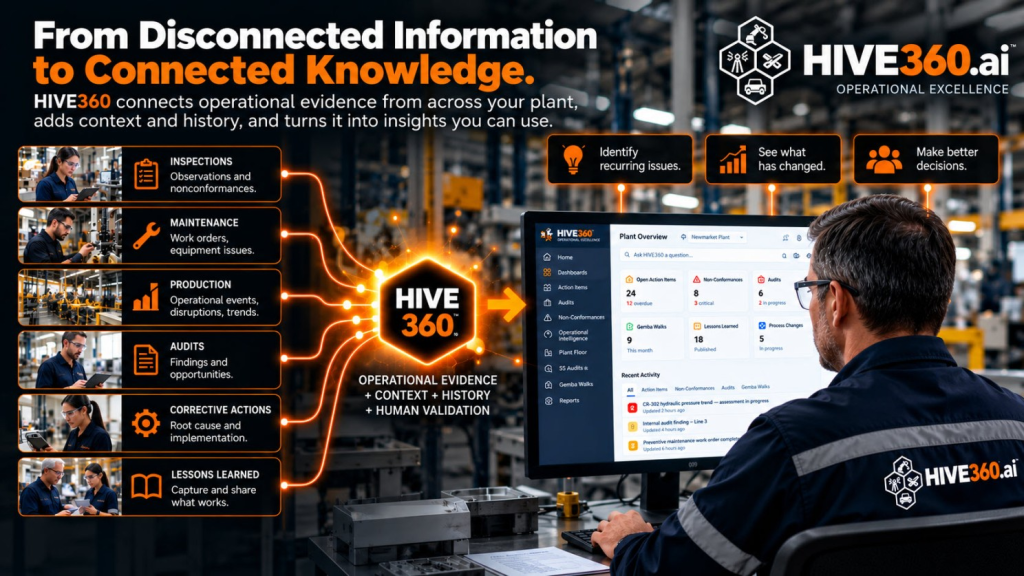
Seeing the bigger picture: when operational evidence connects
Imagine a production line experiencing the same defect for the third time in six months.
Production records the issue. Maintenance investigates equipment condition. Quality raises a nonconformance. Engineering reviews process parameters. An internal auditor may later identify a weakness in the process controls.
Each team may complete its assigned responsibilities.
But if those activities remain disconnected, the organization may struggle to recognize that they are related.
The information exists.
The individual records may even be accurate.
What is missing is the ability to bring the evidence together, understand its context and determine whether it points toward a common underlying problem.
Rather than examining each incident independently, the organization could explore relevant operator observations, maintenance investigations, nonconformance records, corrective actions, process changes and previous effectiveness checks.
That broader view could raise questions worth investigating.
Was a similar condition identified previously? Was the corrective action verified as effective? Did a temporary workaround become part of normal operating practice? Were changes made to the process after the earlier investigation? Could the lesson learned be relevant to another production line or plant?
These are not questions any single record can necessarily answer.
They require evidence from different activities to be considered together.
Related records may suggest a connection, but they don't automatically establish causation. People still need to examine the evidence, challenge assumptions and validate their conclusions.
The value isn't simply in having more records. It's in understanding how those records relate to one another and what they may reveal about the organization's operations.
This is the broader perspective behind HIVE360: helping manufacturers move beyond isolated records toward a more connected understanding of their operations and Continuous Improvement journey.
Manufacturing experience must inform future decisions
Manufacturing processes are not static.
Equipment ages. Materials change. Operating conditions vary. Production requirements evolve. People identify opportunities to improve how work is performed.
As these changes occur, the organization's understanding of its processes should evolve as well.
An operator's observation may reveal a condition that was not anticipated when a process was established. A recurring nonconformance may expose an assumption that needs reconsideration. A maintenance investigation may identify a previously overlooked failure mechanism.
These experiences should inform how the organization evaluates risk, maintains its process controls and makes future decisions.
The Chartered Quality Institute, in Preventing the Recurrence of a Nonconformance, distinguishes correcting an immediate problem from taking corrective action intended to prevent it from happening again.
Restoring a production line to operation may correct the immediate problem. Replacing a failed component may return an asset to service. Containing defective material may prevent it from reaching the customer.
Those actions can be necessary and appropriate.
But they don't necessarily establish why the condition occurred or prevent it from recurring.
Corrective action requires the organization to investigate the cause, determine what needs to change and evaluate whether the action has addressed the problem.
Closing an issue and preventing its recurrence are not necessarily the same achievement.
Where necessary, that learning should also inform relevant procedures, process controls, training and future risk assessments.
Otherwise, valuable lessons risk becoming disconnected from the processes they were intended to improve, allowing the same issues to recur.
Internal auditing contributes to the same learning process
Internal auditing offers another important opportunity to strengthen organizational knowledge.
An internal audit is not simply an exercise in checking whether documentation exists or whether a process has been followed.
It involves examining objective evidence, evaluating processes against applicable requirements and identifying conditions that may need attention.
QMII's AS9100D Internal Auditing Process discusses the importance of objective evidence, following up on audit findings and assessing corrective-action effectiveness.
But what does that mean beyond the audit itself?
Consider an internal auditor who identifies a recurring weakness in an equipment-related process control.
The finding may originate during an audit, but understanding why the condition exists could require input from Production, Maintenance, Quality and Engineering.
Production may know when the condition first appeared. Maintenance may have investigated a similar problem previously. Quality may have recorded related nonconformances. Engineering may have information about changes made to the process.
Each perspective contributes evidence that could help the organization understand the issue more completely.
The auditor's role isn't to replace those disciplines or make their decisions for them. It's to evaluate the process and its controls, identify evidence of nonconformity where appropriate, and follow up on whether the resulting corrective actions have been effective.
And that's where the broader organizational challenge emerges.
If the investigation, corrective actions and lessons learned remain isolated within the audit record, other departments may never benefit from what was discovered.
The finding might be closed, but the knowledge needed to recognize a similar condition elsewhere may still be disconnected.
But what if they could?
What if AI could help an internal auditor, Maintenance Manager or Quality Engineer recognize that a similar issue had already been investigated on another shift, production line or plant?
What if they could explore previous findings, investigations, corrective actions and lessons learned—without having to know where every record was stored?
The opportunity isn't for AI to make the decision or determine the root cause on its own.
It's to help people discover relevant operational knowledge that might otherwise remain hidden.
The value of internal auditing extends beyond identifying nonconformances. It includes helping the organization learn from the evidence, strengthen its processes and prevent recurring problems.
From captured knowledge to contextual operational intelligence
Consider the beginning of a typical day for a Plant Manager.
The production dashboard shows that OEE has declined. Scrap has increased on one line. An unplanned equipment stoppage affected the previous shift.
These indicators matter.
They tell the Plant Manager where attention may be required.
But they don't necessarily explain why those conditions occurred.
Was the equipment issue reported previously? Did Maintenance identify a similar failure three months ago? Was a corrective action implemented but never verified as effective? Has another production line experienced the same condition?
As we discussed in Why Manufacturing KPIs Tell What Happened, Not Why, a dashboard may accurately show a performance decline and subsequent recovery without revealing that an earlier workaround, process change or unresolved condition contributed to the problem.
A recovered KPI doesn't necessarily mean the organization has eliminated the cause of the loss.
And this brings us to an important distinction.
Capturing knowledge, connecting knowledge and understanding knowledge are three different capabilities.
Most manufacturers already possess substantial operational knowledge. It's captured through employee experience, established processes, inspections, maintenance activities, internal audits, investigations, corrective actions and lessons learned.
But much of it remains disconnected, confined to departmental workflows, individual records or systems designed to serve specific functions.
The missing element is often context.
Knowing that an equipment failure occurred is useful.
Understanding which asset was involved, the operating conditions, what employees observed, whether a similar failure occurred previously, what corrective actions were taken and whether those actions were effective tells a much more valuable story.
This is the challenge HIVE360 was designed to address.
HIVE360 is an AI-powered Operational Excellence platform that connects everyday manufacturing activities—including inspections, internal audits, Gemba walks, nonconformances, corrective actions, process changes and lessons learned—within a governed operational environment.
Rather than treating each activity as an isolated record, HIVE360 helps preserve the evidence, context and history behind what the organization does and learns.
That connected foundation creates opportunities for contextual AI insights.
What if you could talk to your plant?
Through Ask HIVE360, including Stephanie, HIVE360's voice-enabled AI assistant, authorized users can ask questions about the operational information available to them and explore relevant evidence, history and relationships.
A Maintenance Manager might want to know whether an asset has experienced similar failures. A Quality Engineer may want to explore whether a new nonconformance resembles a previous investigation. An internal auditor may want to examine the evidence supporting a corrective-action effectiveness assessment.
The objective isn't to replace employees' expertise or allow AI to determine root causes independently.
It's to help people discover relevant knowledge, understand its context and identify what warrants further investigation.
People remain responsible for evaluating evidence, validating conclusions, approving actions and verifying whether improvements have been effective.
As we explored in Can AI Help Plant Managers Make Better Decisions?, AI's value depends on more than producing an answer. A useful response should help people understand the supporting evidence, recognize uncertainty and decide where human judgment is needed.
HIVE360 isn't intended to replace the specialized manufacturing systems organizations already use. Nor is it intended to replace the people whose experience, judgment and expertise keep those operations running.
Its purpose is to connect the operational evidence, knowledge and experience that already exist across the organization, making them more accessible and useful to the people making decisions.
AI doesn't replace experience. It helps preserve it, connect it and put it to work.
The technology can help identify relationships, surface relevant history and provide context, but people remain responsible for evaluating the evidence, applying their expertise and making decisions.
The value isn't simply capturing more information. It's connecting what the organization knows and helping turn that knowledge into actionable operational intelligence.
The cockpit gives you the pulse. HIVE360 gives you the story.
When one plant learns, does the organization?
For manufacturers operating multiple facilities, organizational knowledge faces another challenge: travelling beyond the plant where it originated.
Our earlier article, Is Your Manufacturing Organization Really Connected If Organizational Knowledge Can't Travel?, also examined Hexagon findings indicating that 39% of respondents reported limited feedback between design, manufacturing and quality teams, while 67% lacked an integrated view of data from most of their systems.
Those findings concern connectivity across functions and systems, rather than measuring plant-to-plant knowledge sharing directly.
But they raise a broader question.
If knowledge struggles to move between departments within one facility, what happens when it needs to reach another plant?
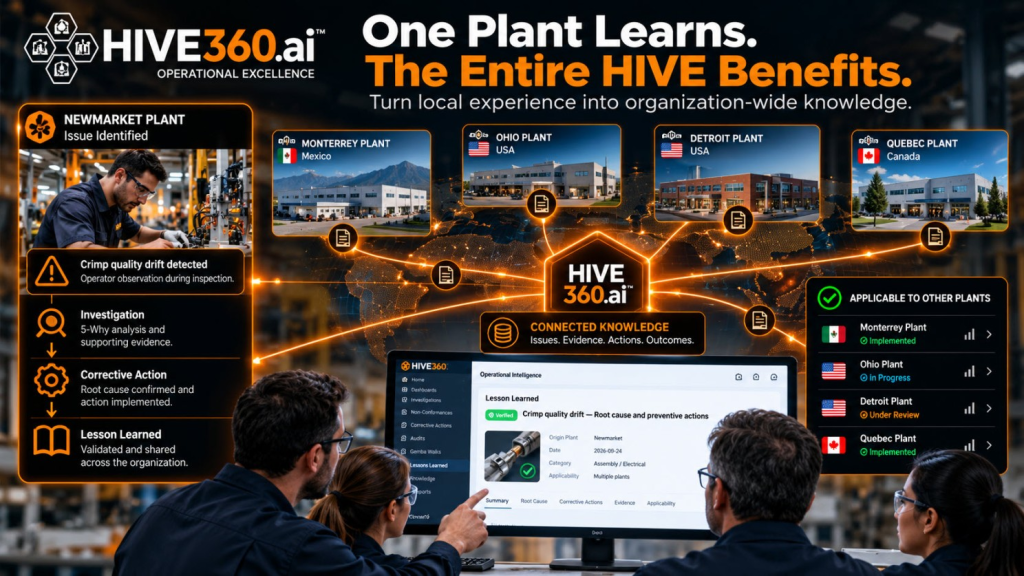
Consider a manufacturer operating similar production equipment at facilities in Ontario, Ohio and Mexico.
At the Ontario plant, a recurring equipment failure is investigated. The team identifies contributing conditions, implements corrective actions and verifies their effectiveness.
The investigation produces valuable knowledge: what employees observed, which operating conditions were present, what evidence supported the conclusions and which actions addressed the problem.
Months later, a similar condition begins developing at the Ohio facility.
Would the Ohio team know that its colleagues in Ontario had already investigated something similar?
Could they discover the previous investigation, understand the conditions involved and determine whether its lessons were relevant to their own equipment?
Or would they begin another investigation without knowing that potentially useful experience already existed elsewhere in the organization?
This is where preserving context becomes essential.
A corrective action that worked in Ontario may not be appropriate in Ohio. Equipment configurations, materials, operating conditions and process controls may differ.
But the previous investigation could provide valuable evidence, questions to consider and warning signs worth examining.
Connected organizational knowledge, supported by contextual AI, creates an opportunity to make those relationships easier to discover across appropriately authorized plant boundaries.
The objective isn't to distribute every report to every facility or automatically apply one plant's solution to another.
It's to make relevant experience discoverable, preserve the evidence behind it and allow people to evaluate whether it applies to their circumstances.
For HIVE360, governed plant-to-plant knowledge sharing is an important part of the broader vision: helping authorized teams learn from relevant experience across facilities while respecting plant-level access, differences in operating conditions and the need for human validation.
One plant may have solved the problem. The real opportunity is ensuring the organization doesn't have to solve it again from scratch.
Continuous Improvement is how the HIVE evolves
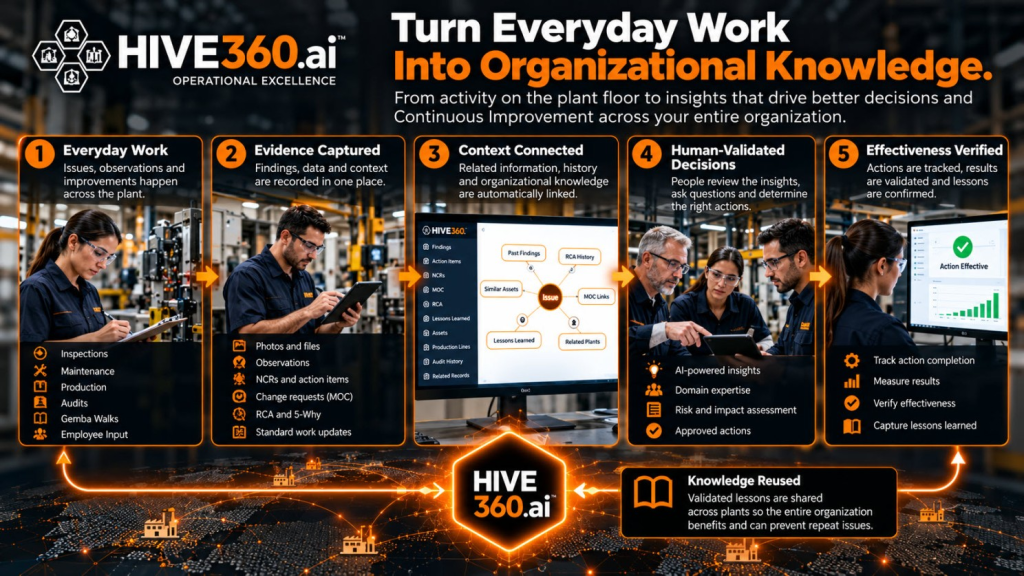
Continuous Improvement doesn't belong exclusively to a CI department, an engineering team or a formal improvement initiative.
It happens through the work people perform across the organization.
The challenge is ensuring that the knowledge generated through those activities becomes part of the organization's ongoing learning.
That requires more than completing action items or closing investigations.
It means preserving the evidence behind decisions, verifying whether changes were effective and making relevant lessons available when similar situations arise.
It also means recognizing that an improvement made in one area may have implications elsewhere.
A lesson learned on one shift could benefit another. A corrective action implemented on one production line may warrant review at another. A process improvement at one plant may offer useful insight to other facilities—provided the conditions and evidence are evaluated before applying it more broadly.
Knowledge needs to travel with its context.
And as new employees join the organization, they should be able to benefit from the experience of those who came before them, while contributing their own observations and improvements to the HIVE.
Continuous Improvement is the ongoing activity. Operational Excellence is the organizational capability and culture that sustains it.
One HIVE. One Purpose.
Manufacturing organizations don't lack experience, information or opportunities to improve.
Every shift, every investigation, every corrective action and every improvement contributes something to the organization's operational knowledge.
The challenge is ensuring that knowledge doesn't remain isolated in departmental systems, individual experience or the plant where it originated.
An investigation completed today may help prevent tomorrow's equipment failure. A lesson learned on one shift may help another team recognize a developing problem. A corrective action verified at one facility may provide valuable insight to another plant facing similar conditions.
But only when that knowledge can be discovered, understood and evaluated in the right context.
That's the opportunity HIVE360 was built to address.
By connecting people, processes, operational evidence and organizational history, HIVE360 helps manufacturers turn everyday operational activities into knowledge that can be shared, understood and applied across the organization.
Contextual AI helps bring relevant knowledge to the attention of the people who need it. People remain responsible for evaluating the evidence, making decisions and verifying the results.
And what the organization learns becomes part of its evolving operational DNA—available to support the next shift, the next investigation, the next generation of employees and the next plant.
Because Operational Excellence isn't simply about how well individual departments or plants perform. It's about how effectively the entire organization learns, improves and prevents problems from recurring.
Turn what your plant does into what it knows.
One HIVE. One Purpose.
Give Your Plant A Voice.
Industry references
- QAD — Why Quality Matters in Manufacturing
- APQC — Capturing and Sharing Manufacturing Knowledge
- APQC — Retaining Critical Knowledge When Experts Leave
- Lean Enterprise Institute — How to Go to the Gemba
- NIST — Towards Knowledge Management for Smart Manufacturing
- Chartered Quality Institute — Preventing the Recurrence of a Nonconformance
- QMII — AS9100D Internal Auditing Process