
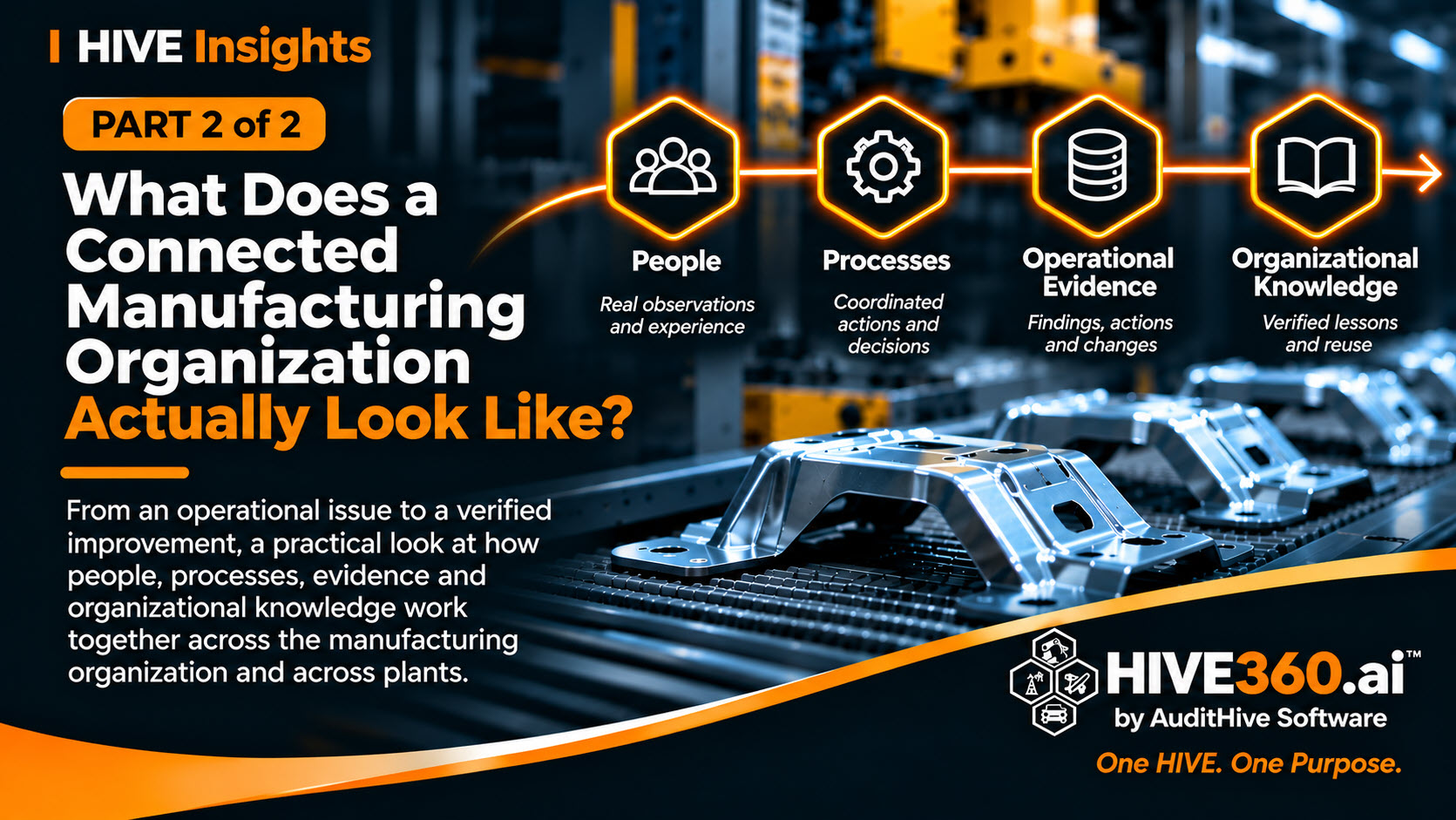
What Does a Connected Manufacturing Organization Actually Look Like?
Part 2 of 2 | Connecting People, Processes, Operational Evidence and Organizational Knowledge
In Part 1, You Probably Don't Need Another Operational Excellence Platform. You Need to Connect What You Already Have. We followed a stamped automotive component through its manufacturing journey, from incoming material and stamping through subsequent processing, inspection and shipment.
Along the way, we explored what happens when a defect is discovered, and the people responsible for investigating it must piece together information from different departments, systems and sometimes manufacturing facilities.
The organization may already have encountered a similar problem. Someone in Maintenance might remember an equipment adjustment, Quality may have records of an earlier nonconformance, or Engineering may have investigated the same process condition months before. Yet finding that information, understanding its relevance and connecting it to the current investigation can become an investigation in itself.
That brings us to the question behind Part 2.
What would the same manufacturing organization look like if its people could draw upon the knowledge, evidence and experience accumulated across its operations?
Not by replacing the systems they already use, but by connecting the knowledge behind their decisions and making it available when and where it matters.
The Same Manufacturing Problem, a Different Approach
Let's return to our stamped component.
During final inspection, a dimensional variation is discovered. Quality initiates a nonconformance, Production reviews the affected material and Maintenance is asked to investigate the stamping equipment. Engineering becomes involved because the condition may be related to tooling wear, process settings or an adjustment made during an earlier production run.
In a connected manufacturing environment, the investigation doesn't begin with each department searching independently for information that might be relevant. The team can examine related operational records, previous findings, equipment history and corrective actions while contributing new evidence as the investigation progresses.
Maintenance brings its understanding of the equipment and earlier interventions, while Quality examines inspection results and the history of similar nonconformances. Engineering assesses the process conditions and technical changes that may have contributed to the variation. Operators and supervisors contribute something equally important: their practical knowledge of how the equipment behaves during normal production and what they observed before the problem was discovered.
An experienced operator may remember an unusual sound, a tooling adjustment or a change in material behaviour that never appeared in a formal report. When that observation becomes part of the investigation, it provides context that the recorded measurements alone may not reveal.
The result is a more complete understanding of the problem, developed through the combined experience of the people involved and supported by the available operational evidence.
From Corrective Action to Operational Continuity
Suppose the investigation determines that a tooling condition contributed to the dimensional variation. Maintenance completes the required work, Engineering recommends a revised process setting, and Quality establishes additional inspection requirements to verify that the process is operating as intended.
Production can resume, but the organization's responsibility doesn't end there.
The team must determine whether the changes affect the control plan, standard operating procedures or work instructions. A formal Management of Change process may be required to coordinate approvals, documentation updates, responsibilities and verification activities. Supervisors must also ensure that employees understand the revised requirements and that the necessary actions have been completed.
This is where shift handover becomes an important part of maintaining operational continuity.
When the afternoon shift hands over the stamping operation to the night shift, the incoming operators and supervisors need more than production quantities, equipment availability and a list of outstanding actions. They need to understand what happened during the previous shift, why the tooling was adjusted, which process conditions changed and whether any concerns remain unresolved.
A structured handover helps ensure that this information is communicated consistently. The outgoing team can review equipment conditions, production concerns, recent maintenance activities and changes to operating procedures, while the incoming team has an opportunity to ask questions and confirm its understanding before assuming responsibility.
But consider what happens several hours later when the night-shift operator encounters a similar dimensional variation. The maintenance technician and engineer who investigated the original problem may no longer be available. Knowing that an adjustment was completed is of limited value if the incoming team cannot understand why it was necessary, what evidence supported the decision and which symptoms might indicate that the condition is returning.
This is where connected organizational knowledge becomes particularly valuable. The incoming team should be able to access relevant equipment history, previous investigations, corrective actions and lessons learned, rather than depending entirely on what someone remembered to communicate during a brief handover.
A shift handover should transfer more than the current status of the operation. It should provide continuity of the knowledge needed to manage what happens next.
But that knowledge shouldn't stop at the handover. Whether it's an operator on the night shift, a maintenance technician investigating a recurring equipment problem or a quality engineer reviewing a nonconformance, people need access to the relevant history and experience of their organization in the context of the problem they're facing.
That means being able to understand what happened before, why particular decisions were made, which corrective actions were implemented and whether those actions proved effective.
The real value comes from bringing together the relevant evidence, operational history, previous decisions and experience of the people involved, so that the team can understand the situation in context and determine what knowledge may apply to the problem they're facing.
These principles are consistent with ISO 9001's requirements concerning organizational knowledge and corrective action, as well as IATF 16949's emphasis on structured problem solving and effectiveness verification in automotive manufacturing.
When the Same Problem Appears at Another Plant
Three months later, a second manufacturing facility begins experiencing a similar dimensional variation.
Its equipment and operating conditions may differ from those at the first plant, but the symptoms are familiar.
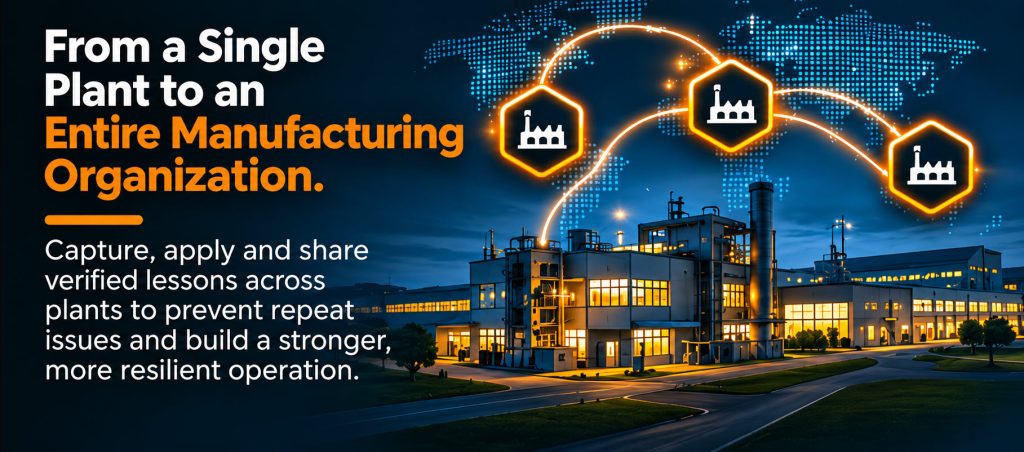
In a connected organization, the second facility can discover the earlier investigation and examine the evidence, corrective actions and verified outcomes before deciding how to proceed.
The engineering team may identify a similar tooling condition, while Quality can compare the inspection results and process characteristics. Maintenance can review the earlier interventions and determine whether they are relevant to the equipment involved.
Perhaps the previous solution is applicable, or perhaps the new investigation establishes that the underlying cause is different. Either way, the team benefits from the organization's accumulated experience rather than repeating work simply because earlier knowledge was difficult to find.
This doesn't mean that a lesson learned at one plant should automatically become an instruction for every other facility. Differences in equipment, materials, processes and customer requirements must be considered, and qualified personnel remain responsible for determining whether previous findings apply.
What matters is that the knowledge is available, supported by evidence and presented with enough context for people to make that assessment.
This brings us back to a question we raised in our earlier HIVE Insights article, “Is Your Manufacturing Organization Really Connected If Organizational Knowledge Can't Travel?” A manufacturing organization may have multiple facilities, shared systems and established procedures, but if the experience gained from solving a problem at one plant cannot benefit another, how connected is that organization?
Connecting manufacturing operations isn't simply about moving information between facilities. It's about ensuring that the knowledge gained through experience can be understood, evaluated and applied wherever it may be relevant.
This challenge extends beyond individual manufacturing organizations. In its research paper Towards Knowledge Management for Smart Manufacturing, the National Institute of Standards and Technology (NIST) identified the difficulty manufacturers face in integrating, sharing and updating knowledge across activities such as process planning, production and inspection. The researchers highlighted that managing manufacturing knowledge requires more than collecting and storing data. Organizations also need ways to connect that information so it can be understood and reused.
Consider our two manufacturing facilities. The first plant has already investigated the dimensional variation, identified the contributing conditions and verified its corrective actions. The second plant now faces a similar problem. The value isn't simply that the earlier records exist, but that the second team can understand the circumstances behind the original investigation, evaluate the relevance of its findings and apply that knowledge to its own situation. This is the practical challenge NIST's research helps illustrate: making accumulated manufacturing knowledge useful beyond the activity or location where it originated.
A manufacturing organization with multiple facilities has an enormous collective resource in the experience of its people. Connecting that experience allows knowledge developed in one location to become useful elsewhere without removing local responsibility for decisions.
How AI Can Help People Use What the Organization Knows
Manufacturing organizations already rely on software systems for production, quality, maintenance, engineering and business operations. These systems serve important purposes, but the information needed to understand an operational problem can still be distributed across separate records and activities.
The opportunity is to make the relationships between those records easier to explore and understand.
This is the thinking behind HIVE360.ai by AuditHive Software.
Within HIVE360, operational activities such as inspections, internal audits, nonconformances, root cause investigations, corrective actions, equipment records, managed changes and lessons learned contribute to a connected body of organizational knowledge.
This is where HIVE360's AI Assistance, Stephanie, brings another dimension to connected manufacturing knowledge. Rather than expecting employees to know which records to search or which department previously investigated a problem, Stephanie helps them explore relevant information in the context of the issue they're dealing with.
Whether someone is working the morning shift, investigating a recurring nonconformance or reviewing a problem encountered at another facility, the objective is the same: make the organization's accumulated knowledge accessible when it can help inform the next decision.
Returning to our stamped-component example, a quality engineer might ask whether similar dimensional variations have been recorded previously. Maintenance could examine earlier equipment investigations, while Engineering might explore the history of process changes and the corrective actions associated with them.
Stephanie helps bring relevant information and supporting context into view, allowing people to examine the available evidence and understand how different operational activities may relate to one another.
Importantly, the responsibility for interpreting evidence, determining root cause, approving changes and verifying outcomes remains with qualified personnel. AI assistance supports their work by making organizational knowledge more accessible, not by replacing their judgment.
AI doesn't replace experience. It helps preserve it and makes it more accessible to the people who need it.
Giving Plant Management the Story Behind the Numbers
At the plant management level, connected organizational knowledge offers another important benefit.
A plant manager may already have dashboards showing production output, OEE, downtime, scrap, quality performance and corrective-action status. These indicators help reveal how the operation is performing, but they don't always explain the circumstances behind a change in performance.
Consider a recurring equipment problem that contributes to several downtime events. The dashboard may show the accumulated production loss, but understanding why the problem continues requires access to the earlier investigations, maintenance interventions, process changes and effectiveness reviews.
It may also reveal that important observations were made during previous shifts but were never connected to the investigation or communicated to the people responsible for preventing recurrence.
This is the role of the HIVE360 Plant Cockpit: bringing operational performance and the supporting organizational context closer together so leaders can identify what requires attention and explore the evidence behind it.
Rather than asking each department to prepare another explanation, management can work toward a shared understanding of the issue, its history and the improvement activities underway.
As we explored in our earlier HIVE Insights article, Manufacturing Doesn't Have a Data Problem. It Has a Decision Problem, the value of operational information ultimately depends on whether people can use it to make better-informed decisions.
The cockpit gives management the pulse of the operation. Connected organizational knowledge helps explain the story behind that pulse.
Operational Excellence Becomes an Organizational Capability
The manufacturing organization we've followed through these two articles illustrates something broader than a single quality problem or improvement initiative.
An operator's observation contributes to an investigation. Maintenance, Quality, Engineering and Production combine their expertise to understand the problem and determine the appropriate response. Corrective actions lead to controlled changes, updated work instructions and verification activities, while shift handovers help preserve continuity as responsibility passes from one team to another.
The resulting knowledge can then support future investigations, internal audits and improvement activities, including those taking place at other manufacturing facilities.
These are not unfamiliar activities. Many organizations already perform them every day.
What changes in a connected environment is the ability to preserve the relationships between those activities so that the experience gained through one problem can continue contributing to future decisions.
A connected manufacturing organization isn't defined by how many systems it has connected. It is defined by how effectively its people, processes, operational evidence and organizational knowledge work together.
That's the opportunity we're pursuing with HIVE360.ai.
Not another isolated repository of manufacturing information, but an operational environment designed to connect the evidence, experience, decisions and improvements that already exist throughout the organization.
In Part 1, we asked what happens when the knowledge behind a finished product doesn't travel as effectively as the product itself.
The answer isn't simply better documentation or another dashboard. It's ensuring that the people responsible for manufacturing performance can benefit from what their organization has already experienced, investigated and learned.
Every finished product has a story, shaped by the people, processes and decisions behind it.
Your plant has a story to tell. But not all of that story has been reaching the people who need to hear it.
With HIVE360.ai, now you can.
When people, processes, operational evidence and organizational knowledge work together, the entire manufacturing organization benefits from what its people know and learn.
One HIVE. One Purpose.
Related Reading and Industry References
HIVE Insights
- Part 1: You Probably Don't Need Another Operational Excellence Platform. You Need to Connect What You Already Have.
- Is Your Manufacturing Organization Really Connected If Organizational Knowledge Can't Travel?
- Does Your Manufacturing Organization Have Governed Knowledge—or a Data Landfill?
- Manufacturing Doesn't Have a Data Problem. It Has a Decision Problem.
Industry References
- Tervene: Structuring Shift Handovers in Manufacturing
- Augmentir: Shift Handover in Manufacturing
- NIST: Towards Knowledge Management for Smart Manufacturing
- ISO 9001:2015, Clause 7.1.6, Organizational Knowledge; Clause 10.2, Nonconformity and Corrective Action
- IATF 16949:2016, Section 10.2.3, Problem Solving