
You Probably Don't Need Another Operational Excellence Platform. You Need to Connect What You Already Have.
Part 1 of 2 | Every Finished Product Has a Story. But What Happens When the Knowledge Behind That Story Doesn't Travel?
Manufacturing organizations have invested decades in improving how they operate. They have established quality management systems, implemented production technologies, developed maintenance programs, introduced continuous improvement initiatives and built teams of experienced professionals who understand their processes.
Along the way, they have accumulated an enormous amount of knowledge.
Some of that knowledge exists in inspection records, maintenance histories, engineering documentation, nonconformance reports and corrective action investigations. Some resides in the experience of operators, technicians, engineers and other employees who have spent years learning how equipment and processes actually behave.
Yet an important question remains: Can the people who need that knowledge find it, understand its relevance and put it to work when it matters most?
A Finished Product Has a Story
Consider a manufacturer producing stamped-steel components for the automotive industry.
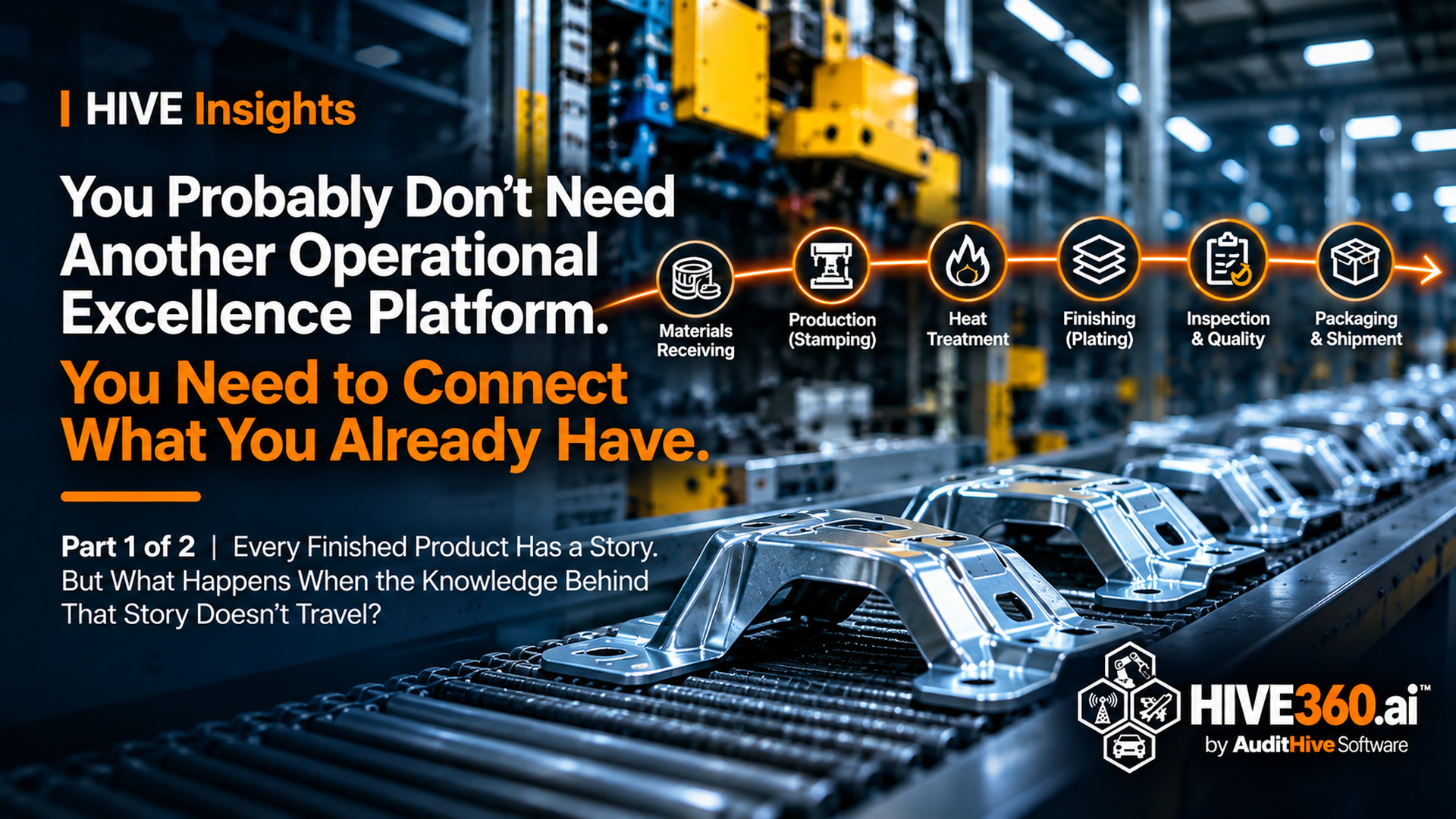
The story begins when coils of steel arrive at the facility. Materials are received, identified, inspected and stored before entering production. A coil is loaded onto a press line, where the material is fed through tooling and transformed into components that must meet defined dimensional and quality requirements.
Depending on the application, those components may undergo heat treatment, additional inspections, surface finishing or plating. Some operations may occur at another facility before the finished parts are packaged and shipped to the customer.
Throughout that journey, many people contribute to the outcome.
Production operators monitor the process and identify unusual conditions. Maintenance technicians keep equipment operating and investigate mechanical issues. Engineering establishes process parameters and evaluates changes. Quality personnel verify requirements, investigate nonconformances and support corrective actions. Material handlers and logistics teams manage the movement and traceability of components.
Each activity generates information, observations and decisions that become part of the product's manufacturing history.
The physical product follows a defined manufacturing route. But does the knowledge generated along the way travel just as effectively?
When a Defect Is Discovered, a New Chapter Begins
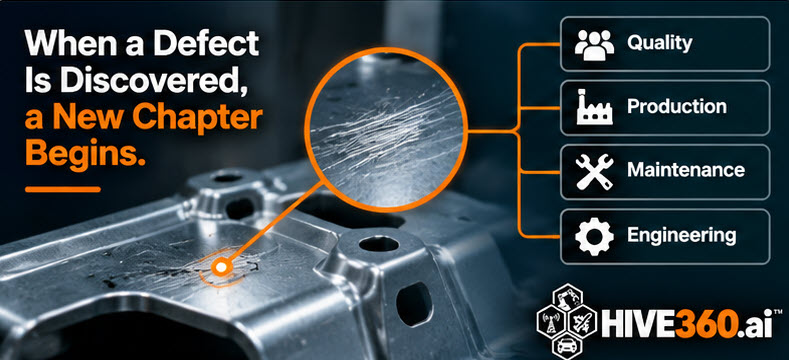
Imagine that a surface-quality defect is discovered during final inspection. Alternatively, the problem might first become apparent when stamped and heat-treated components arrive at another facility for plating.
The defect has been identified, but its origin is not immediately clear.
Was the condition present in the incoming material? Did something change during stamping or heat treatment? Could handling, storage or transportation have contributed? Is the condition related to the finishing process, or did that process simply make an earlier problem visible?
Determining the answer requires more than examining the operation where the defect was discovered.
Quality may review inspection results and previous nonconformances. Production may examine operating conditions, tooling and shift records. Maintenance may contribute equipment observations or repair histories. Engineering may investigate material characteristics, process parameters or changes introduced before the issue appeared.
If the component has travelled between facilities, the investigation may also involve personnel at another plant. Depending on the circumstances, suppliers or customers may contribute relevant evidence.
Each department contributes an important part of the story, but no single department necessarily has the complete picture.
The investigation becomes an exercise in connecting information, understanding relationships and reconstructing the circumstances that led to the problem.
If every finished product has a story, shouldn't the people investigating a problem be able to follow that story, uncover the hidden conditions that contributed to the defect and understand why they weren't detected earlier?
What If the Organization Has Seen This Before?
Now consider another possibility.
Six months earlier, a similar surface-quality issue occurred on a different production line. An investigation was completed, the contributing conditions were identified, corrective actions were implemented and their effectiveness was verified.
The organization learned something valuable.
But where does that knowledge reside today?
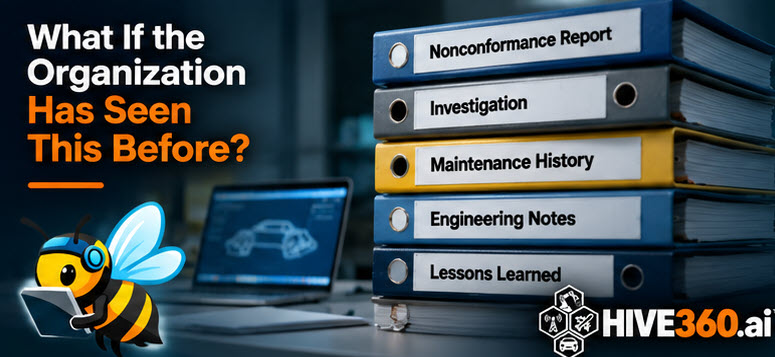
Perhaps the original investigation is stored in a quality system. Supporting maintenance observations may be in another application. Engineering notes might be attached to a project folder, while an experienced technician remembers an unusual operating condition that never made it into the final report.
The investigation was completed, but its knowledge may remain fragmented.
But can today's investigation team uncover the conclusions and lessons from that earlier investigation? And if they do, can they determine whether those lessons apply to the current situation?
This is not simply a hypothetical concern about poor documentation. The National Institute of Standards and Technology has described manufacturing situations where inconsistent terminology and disconnected information make recurring problems difficult to understand. In one example involving hydraulic leaks, a manufacturer recorded more than 40 incidents over three months, but the information was not captured consistently enough to make meaningful analysis straightforward.
NIST has also explored the importance of knowledge management in smart manufacturing, recognizing that information must be organized and made usable if manufacturers are to benefit from it.
ISO 9001 similarly recognizes organizational knowledge as something that must be determined, maintained and made available to support processes and product conformity.
Now consider the difference that knowledge could make to the team investigating today's defect.
Instead of beginning without awareness of the previous investigation, the team could examine earlier evidence, understand the conditions that contributed to the original problem and evaluate whether the verified corrective actions offer useful guidance.
That does not mean assuming the root cause is identical. It means giving experienced people a more informed starting point.
The real opportunity isn't simply to preserve organizational knowledge. It's to put that knowledge to work when and where it matters most.
Different Responsibilities. One Manufacturing Organization.
The same challenge extends well beyond quality investigations.
A maintenance technician may recognize an equipment condition that has occurred before, but the previous repair history and associated lessons may be difficult to locate. An internal auditor may identify a recurring weakness without visibility into similar findings at another facility. A continuous improvement team may develop an effective solution that never becomes available to colleagues facing comparable challenges.
Meanwhile, the plant manager is responsible for the performance of the entire operation.
These employees have different responsibilities, but their work is connected through the same manufacturing processes, equipment, operating conditions and business objectives.
In our earlier HIVE Insights article, Is Your Manufacturing Organization Really Connected If Organizational Knowledge Can't Travel?, we explored why organizational connectivity must mean more than connecting people through meetings, reports and software.
A manufacturing organization becomes more connected when the knowledge created through its daily activities can move across functional boundaries and support the next person who needs it.
Connecting Today's Problems to Tomorrow's Objectives
Every manufacturing organization has performance objectives. They may involve reducing scrap and rework, improving equipment availability, strengthening quality performance, reducing recurring failures or increasing productivity.
Achieving those objectives requires coordinated effort across departments.
An improvement initiative may address an immediate issue successfully, but what happens afterward? Are the results verified? Are the lessons preserved? Can another team understand why the improvement worked and whether it could apply elsewhere?
Completing an improvement project matters. Understanding why it worked, verifying its effectiveness and preserving what was learned helps the organization sustain those improvements and apply that knowledge elsewhere.
This becomes especially important as organizations change.
Experienced employees retire or move into new roles. Equipment is replaced. Production processes evolve. New facilities are introduced, and responsibilities shift between departments.
When knowledge remains dependent on individual memories or disconnected records, the organization risks repeatedly learning lessons it has already paid to acquire.
Perhaps the Answer Isn't Another System
Manufacturers are not necessarily short of software, dashboards, reports or operational data.
Many already have substantial investments in systems that perform essential functions. The challenge is that the information, experience and lessons generated through those systems do not always come together in a way that supports the people making decisions.
As we discussed in Does Your Manufacturing Organization Have Governed Knowledge—or a Data Landfill?, collecting information is not the same as creating accessible, trustworthy organizational knowledge.
The objective should not be to replace every existing application or create another place to store documents. It should be to make the knowledge already being generated more connected, meaningful and useful.
Return to our stamped-steel component.
Its manufacturing journey involved multiple departments, processes, pieces of equipment and potentially more than one facility. When a defect appeared, the organization needed to reconstruct that journey to understand what happened and why.
But the evidence, experience and lessons required to tell that story may already have existed.
You may already have much of what you need. The opportunity is making better use of it.
In Part 2, we'll return to this manufacturing example and explore what changes when operational evidence, human experience and verified organizational knowledge become connected—and how that can help manufacturers investigate problems, make better decisions and learn across their operations.
One HIVE. One Purpose.
References and further reading
- National Institute of Standards and Technology — When a Manufacturer Asks, “How Do We Get Smart?”
- National Institute of Standards and Technology — Towards Knowledge Management for Smart Manufacturing
- International Organization for Standardization — ISO 9001 Quality Management
- HIVE Insights — Is Your Manufacturing Organization Really Connected If Organizational Knowledge Can't Travel?
- HIVE Insights — Does Your Manufacturing Organization Have Governed Knowledge—or a Data Landfill?